


Card Author:
Location:


THE CHURCH OF SAINT PIETRO
THE HISTORY
The first foundation of a church on this site goes back to ancient times. An Ecclesia S. Petri de Castanea is mentioned in the Papal Bull of Pope Leone IV to the Bishop Virobono di Tuscania, a document which contains a precise and scrupulous definition of the boundaries of the diocese, as a cell depending from the Benedictine abbey of Farfa in Sabina. A further document of the XIII century, kept in the Benedectine Archive of the Province of the Marche provides more precise information. Bishop Filippo, who was then under the title of Tuscania and Viterbo, bestowed the church of St.Pietro de Castanea in the city of Viterbo with the connecting house and gardens to the Brothers of the Penitence of Christ, commonly known as the ‘Sacked’ because of the rough wool tunic that they wore as their canonical dress. Unsupported by other documents, the chronicler Giacinto Nobili, Dominican Padre of S. Maria in Gradi, declares that San Pietro was built on following the wishes of Cardinal Raniero Capocci and given to the Cistercians. A parchment of 1268 which is kept in the Archives of the Brothers of the Penitence of Christ is proof, on the other hand, that the ‘Sacked Brothers’, known as such due to their rough sackcloth, were already living in that convent. These brothers, who were under the rule of the Benedictines of Cluny, were followed in rapid succession by the congregation of the Silvestrini founded by Silvestro Guzzolini, who were also part of the Benedictine family. The foundation had a difficult life and at the end of the fifteenth-century it was governed by secular commissioners like Trogolo Gatti and Battista Capocci. Soon after this, in the Bull dated the 30th June, 1498, Alexander VI bestowed it to the Gerolamini brothers of Fra’ Pietro Gambacorta of Pisa, or the Gerolamini of Fra’ Pietro. The complex of St. Pietro enjoyed its most important stage under these brothers because they took on the obligation of the re-founding of the church which took on the forms that it has today. The Scalzetti (Bare Footed) or Penitents of Jesus Nazarene followed the Gerolamini who kept the church until their suppression in 1935. The Giuseppini of St. Leonardo Murialdo are the present tenants of the ancient complex of St. Pietro del Castagno and have transformed St. Pietro into the seat of a prestigious centre for theological studies..
THE EXTERIOR
The church was completely renovated in the XVI century, with a generous aid from the Cardinal Raffaele Riario. In the following century, between 1621 and 1622, Cardinal Scipione Corbelluzzi took on the responsibility of the restoration of the façade and the staircase. The cardinal’s crest, a rampant dog, appears repeatedly in the balustrade which flanks the steps and on the tympanum of the façade. These works substantially modified the original Romanesque church into its present day appearance. Further restoration works were carried out at the beginning of the 1900s by the Benedictine father Luca Linke and other alterations were done in 1983 but which did not change the architectonic structure. The façade is articulated into two levels. It is plastered and divided up by peperino stone pilasters which are crowned by figures of angels in the upper part. A large window illuminates the inside of the church. On the string-course corbel we can read the inscription which commemorates the dedication of the church to the Prince of the Apostles, dated 1622. The union to the Basilica of San Giovanni in Laterano of Rome is written in the portal. It came about by a diploma in 1618.
THE INTERIOR
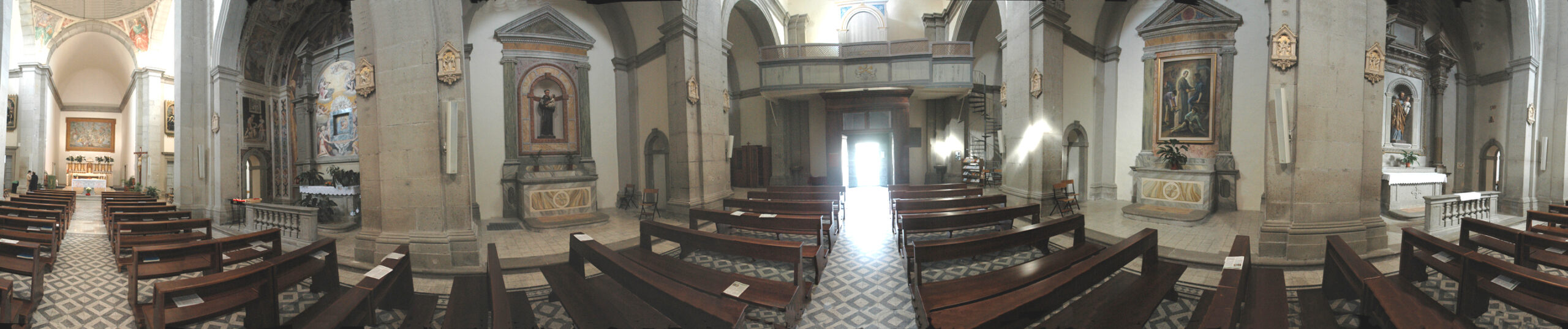
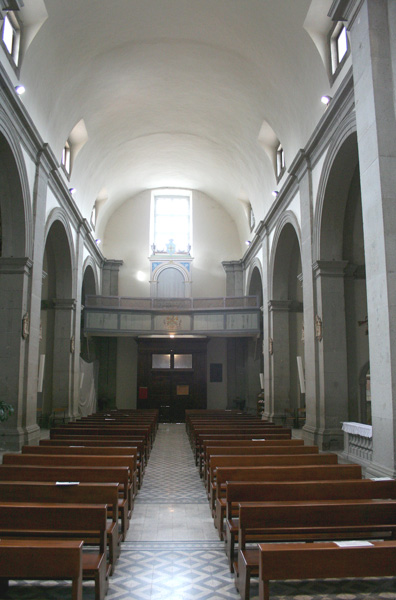
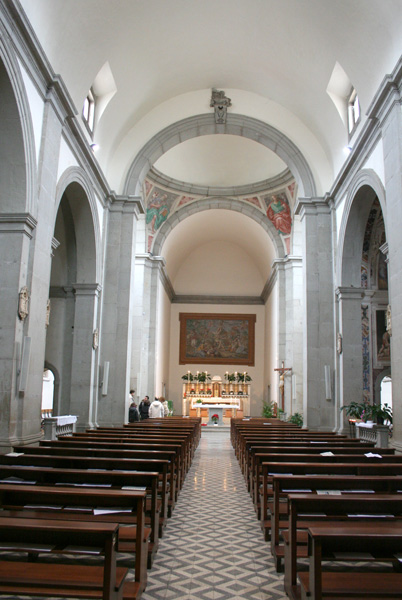
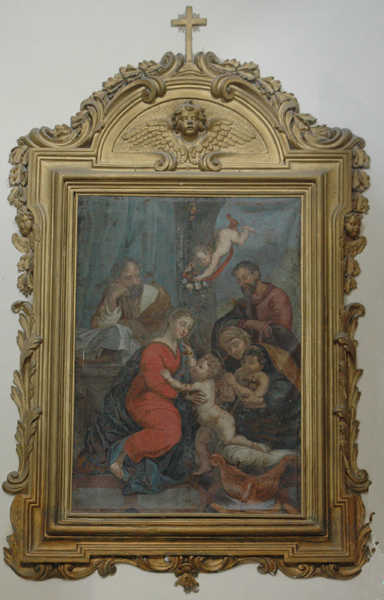
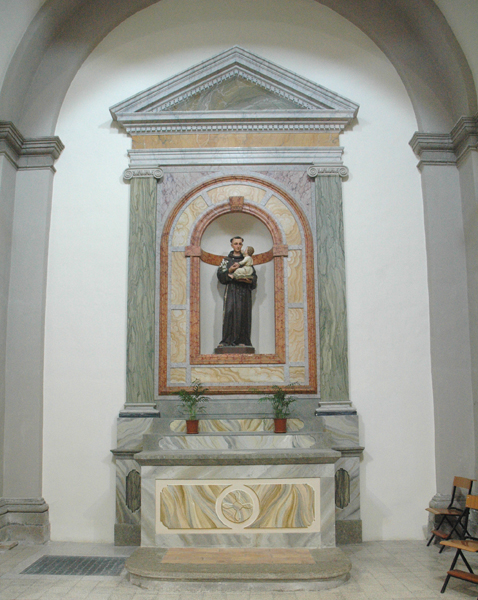
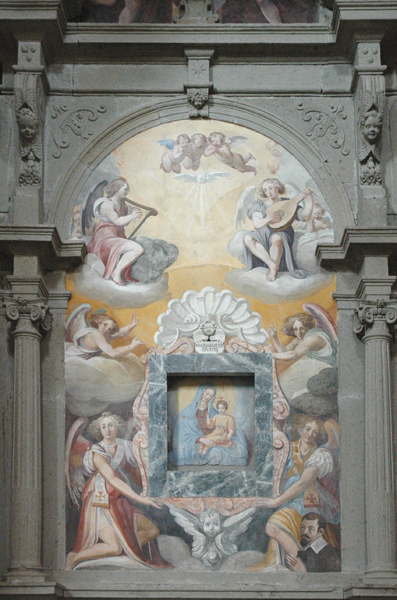
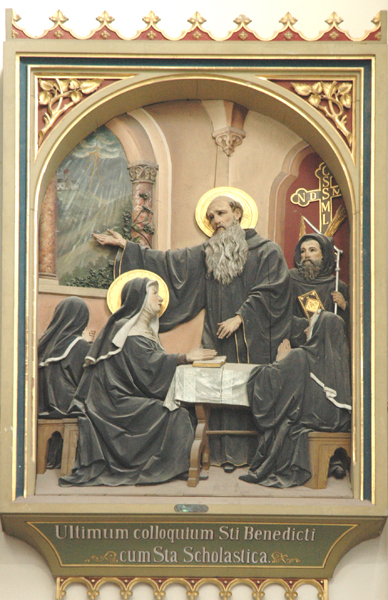
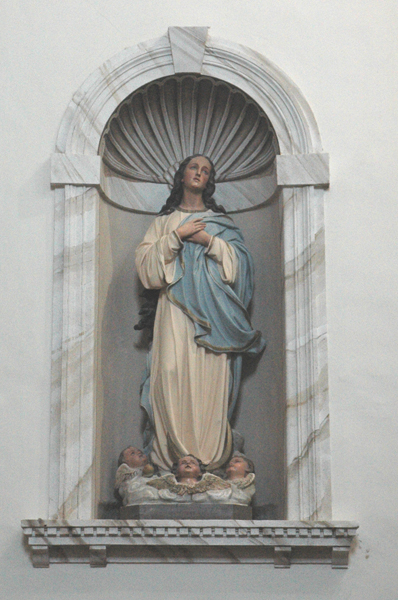
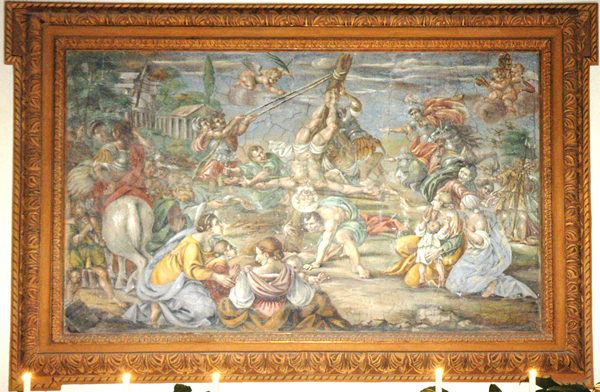
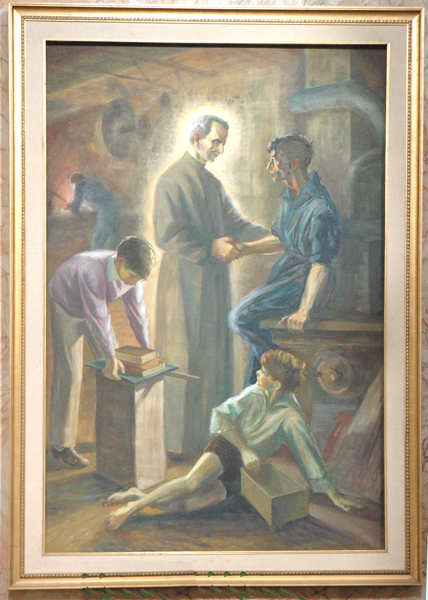
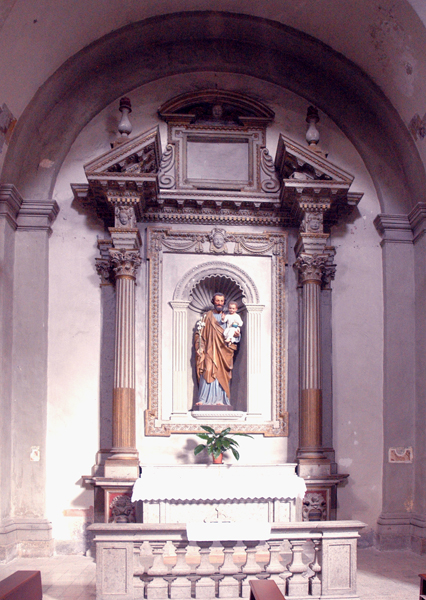
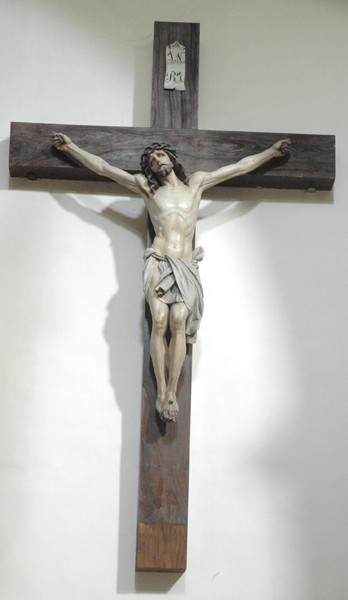
The inside of the church has one hall with three chapels on each side connected to each other. The transept does not project and is covered by the large vaulted dome. The rectangular presbytery has a cloakroom on each side thus concluding the iconographic plan. The Evangelists ( XVII century) are depicted in the webs (1). On each side of the main entrance stands a font in peperino stone with round basins on top of delicate columns. The altarpiece in the first chapel on the right depicts (2) the Madonna and Saint Joseph with the Child between St. Elizabeth, St. Zacharias and St. John the Baptist as a child (XVIII century). An elegant eighteenth century altar can be seen in the second chapel (3) dedicated to St. Anthony of Padua. The third chapel (4) belonged to the Angelini-Mosti noble family who originated from the countryside around Viterbo. The name of their lineage appeared for the first time in records of the XV century. In 1607, Vincenzo, one of their exponents, manag ed to gain authorisation from the Gerolamini of San Pietro del Castagno to build a chapel dedicated to Our Lady of Grace. This dedication derived from the painting which is believed to be miraculous and which hangs in the middle of the chapel. This group of the Virgin with the Child originally came from the hermitage of Our Lady of Grace on the Roman road near Santa Maria della Grotticella. The oldest picture is framed and has a crown of musician angels and the painted decorative complex of this chapel is completed by paintings of the Crucifixion, the Crowning of the Virgin Mary, the Decollation of St John the Baptist, and the Discovery of the Cross and St Helen. The artists of these works are still unknown today and despite their modesty, answer to the contemporary models of the Roman group. In the right-hand wing of the transept (5), we can see a large wooden panel in high relief portraying the Last conversation of St. Benedict with St. Scholastica. There is another panel of identical dimensions and workmanship in the left-hand wing (6) depicting St. Mauro, S. Benedict and St. Placid. Both of these are by artists of the beginning of the twentieth century. In the transept we can also see a statue portraying the Immaculate Conception. A signed and dated Crucifixion of St. Peter (7) is painted on the end wall of the presbytery. There is an inscription on a scroll in the left-hand corner of the painting where, apart from the first line which is unclear, we can read the words: (.)/FIECTI VITERBI/ETATIS SUAE/ANNORU(m) XVIII/PINXIT 1696. The scene represents, rather poorly, the assembly of the style of Cortona in the groups in the foreground of women with children, and of the style of Lanfranco, in the St. Peter’s crucifix and in the torturers who overshadow the disposition of St. Andrew of Lanfranco in the Roman church of the same name. We can recognise the earlier work of Giuseppe Sisto Fietti as the inscriber of the Fiecti Viterbi who was only known for his skilful writing which we can see in the book on the history of Viterbo called Istoria della città di Viterbo by Padre Feliciano Bussi printed in 1742. There is a beautiful Baroque wooden crucifix in the apse. On the left, in the last chapel (8) there is a eighteenth-century altar with columns holding up some cut off tympanums. Inside there is a modern statue of St. Giuseppe (XX century). The chapel was created under the patronage of the Mancini family who were descendants of an ancient noble family of Florentine origin and therefore new citizens of Viterbo. Some of the family members settled in the town during the XVI century. In the second half of the seventeenth-century, the city chronicles registered various artistic patronages by this family. In the years 1621-1622 they commissioned the Viterbian Maestro Bortolomeo Cavarrozzi in Rome to paint a canvas of St. Philip (which has been lost) which was to be placed on the altar in the chapel dedicated to the saint, which was under their patronage in the church of St. Peter of Castagno. In the central chapel on the left (9) we can see the modern altar-piece of St. Leonardo Murialdo with workers and students, dating back to the 1950s, by Padre F. Verri. In the first chapel on the left there is a wooden Crucifix (10), a nineteenth-century copy of a Baroque-style Crucifix. In the sacristy (11) we can see a canvas of St. Augustine (?), S. Alessio (?) and the figure of a hermit dressed in humble animal skins with a crown and an exquisite altar-piece in a poor state of preservation depicting the Madonna and St. Crispin Bishop (XVIII century).
ESSENTIAL BIBLIOGRAPHY
AA. VV., Tuscia Viterbese, vol. I, Roma, 1968.
F. Bussi, Istoria della città di Viterbo, Roma, 1742.
Attilio Carosi, Chiese di Viterbo, Viterbo, Agnesotti, 1995.
Dizionario della Pittura e dei Pittori, Torino, Einaudi, 1989.
F. Egidi, Guida della città di Viterbo e dintorni, Viterbo, 1889.
Italo Faldi, Mostra di restauri, in “L’arte nel viterbese”, Viterbo, 1965.
Italo Faldi, Museo Civico di Viterbo. Dipinti e sculture dal Medioevo al XVIII secolo, Viterbo, 1955.
Italo Faldi, Pittori viterbesi di cinque secoli, Roma, 1970.
Italo Faldi, Restauri acquisti e acquisizioni al patrimonio artistico di Viterbo, catalogo, Viterbo, Palazzo dei Priori, 1972.
Augusto Gargana, Viterbo. Itinerario di Augusto Gargana, Viterbo, 1939.
Il 1400 a Roma e nel Lazio. Il 1400 a Viterbo, cat. mostra, Roma, De Luca Editore, 1983.
La pittura in Italia, Milano, Electa, 1989.
A. Muñoz, Uno sguardo al nuovo Museo Civico di Viterbo, in “Per l’inaugurazione del Museo Civico di Viterbo”, Viterbo, Agnesotti, 1912, pp. 33- 45.
G. Oddi, Le arti in Viterbo, Viterbo, Agnesotti, 1882.
Cesare Pinzi, I principali monumenti di Viterbo. Guida pel visitatore, Viterbo, Agnesotti, 1911.Cesare Pinzi, Storia della città di Viterbo, voll. I-III, Roma, 1887/89, vol. IV, Viterbo, Agnesotti, 1913.
A. Scriattoli, Viterbo nei suoi monumenti, Roma, 1915-20.
Giuseppe Signorelli, Viterbo nella storia della Chiesa, Viterbo, 1907-1969.
Mario Signorelli, Guida di Viterbo. Monumenti del centro cittadini, Viterbo, Agnesotti, 1964.
Mario Signorelli, Storia breve di Viterbo, Viterbo, Agnesotti, 1964
Simona Valtieri, La genesi umana di Viterbo, Roma, 1977.
Alecci Romolo, Chiesa di S. Pietro: ricostruzione storico-artistica, Viterbo 1997.


