

FOUNTAIN OF SANTA MARIA IN POGGIO
The fountain of Santa Maria in Poggio is one of the oldest which has the typical form of a spindle in Viterbo. This fountain shows the same artistic elements of the others fountains of the thirteenth century.


The fountain of Santa Maria in Poggio is one of the oldest which has the typical form of a spindle in Viterbo. This fountain shows the same artistic elements of the others fountains of the thirteenth century.
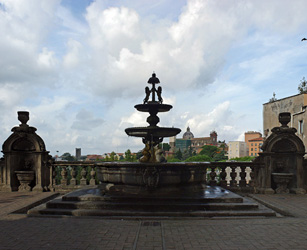
The construction of the fountain in the courtyard of the palace was undertaken in 1624 at the behest of the City Council. The palace was the base of the governor’s estate, then of the priors and now of the mayor.

The Fountain of San Giovanni Zoccoli, commonly referred to as the fountain of Piazza Dante. This fountain was most likely built in 1268, as evidence by the inscription on the cusp of the fountain. The inhabitants of the district independently decided to raise the money to build the fountain. The historian Scriattoli, refers to an archival document that states the construction of the fountain was decided in the year 1268.

Author: Consulenza scientifica Dr.sa Simona Gigliotti Location: PIAZZA PIANO SCARANO Date: 1376 Go to the DescriprionVirtual Tour Virtual Tour Close Located in the main square of the ancient district Piano Scarano, the fountain is presented in its original form as when it was built in 1376. This fountain represents the evolution of the spindle shape…

The Fountain of San Faustino was built around 1251. It is located in Piazza San Faustino, inside the city walls since the year 1210. In the district, the painter Lorenzo di Jacopo was born. He was the creator of the famous frescoes in the chapel of Mazzatosta, located inside the Chiesa di Santa Maria della Verità.

Author: Consulenza scientifica Dr.sa Simona Gigliotti Location: Piazza Fontana Grande Go to the DescriprionVirtual Tour Virtual Tour Close Fontana Grande was built in the year 1212 by the will of the City. Its creation was entrusted to stone masons, Pietro and Bertoldo di Giovanni, whose names appear in the lower basin of the epigraph placed…

This fountain was created by Pope Alexander VI to mark the renewal of the square, in which he also changed the name from Piazza di Santo Stefano (Saint Sthephen square) to Platea Nova Alessandrina.
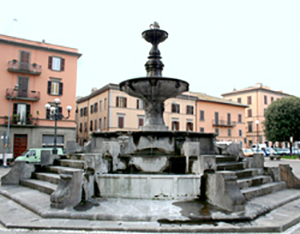
During the Middle Ages the fountain was known as San Pietro alla Rocca. It underwent its first restoration in the second half of the fifteenth century, and a seven-foot-long pool was added.

The fountain of San Tommaso or also known as the Fountain of Death, dates back to the middle of the 13th century and is one of the oldest in the city of Viterbo. The name is closely linked to the context in which the fountain was made. The present name was used only in the sixteenth century, when the sacred building Oration and the Brotherhood of Death were housed inside the complex.

The fountain is mentioned for the first time in public documents in 1450, when the reforms are referred to the contract between the town of Viterbo, and Cecco da Mugnaio, who was in charge of its restoration.