


Card Author:
Location:
Date:








THE CHURCH OF SANT'IGNAZIO
THE HISTORY
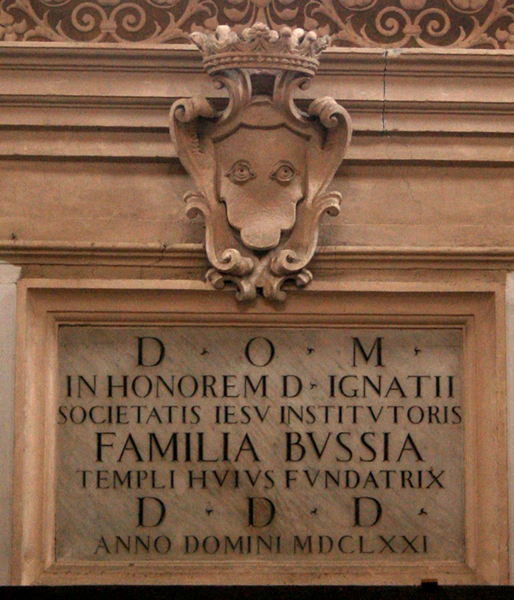
The foundation of the church of S. Ignazio was made in 1671 to the work of the Bussi family in favor of the società di Gesù, guaranteed in wall of counter with a marble inscription. The construction of the Church of S. Ignazio began in 1662 and ended in 1670. It was opened to worship on July 30 1671 thanks to the financial contribution of the Bussi family, with eight thousand shields, in particular by Girolamo, forming part of the Order of the Jesuits. One other part of contributions arrived from the Spadenzi family. As written on the inscription inside the church, Spadenzi donated 1,500? gold shields to the rising of the church. The church was blessed by Rodolfo Acquaviva, Governor of the Estate and Archbishop of Laodicea. The event was recorded with the inscription on the counter wall above the main door with the marble coat of arms inserted of the Bussi family D.O.M., in honoem D(ivi) Ignatii, Societatis iesu institutoris famiglia Bussia templi huius fundatrix ddd anno domini MDCLXXI. The legacy of the Spadensi did result in other, more consistent, of Domenico Brunacci which surrendered his land to the Quercia. The Brunacci family, the original of Vasanello, was in Viterbo already in the middle 14th century. Their coat of arms is made of silver and it represents two claws of bear passing in crosses of S. Andrea, with the nails turn in tall. Until 1774 and subsequently between 1868 and 1872 the Jesuits stayed in this church. In 1837 the Jesuits paid for the work of restoration of the front wall with the help of Vincenzo Federici for a cost of three thousand shields. To the end of the 19th century Castore Costantini was in charge of the restoration of the inside of the church. In the inside one gravestone remembers that in 1821 Pope Leone XIII received in this church his First Communion. The church was entrusted to the therapeutic community called CEIS during 1980. Recently (January 21, 2014) has been entrusted by the Bishop Lino Fumagalli to the Romanian Orthodox parish of “San Callimaco Cernica”.
THE EXTERIOR
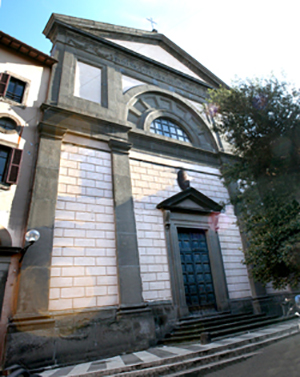
The front, split in two horizontally decorated in low of pilaster in peperino stone local of Viterbo. At the top of the front wall there is a window embellished with an arch with rectangular mirrors. The decoration at the top is composed of fruit ornaments. The front is overflowed of a gable. Under the gable is carved the writing “In ho. S Ignatti I.sem erexit a. D. MDCCCXLIII.” The hight of the front results different from the hight of the aisle. Smooth and plaster the side fronts. The side chapels presented to the outer different heights. The large bell and the medium bell were made by the Company of the Jesus in 1727. The small bell has an inscription dated in the year 1280 with enrollment in gothic character.
THE INTERIOR
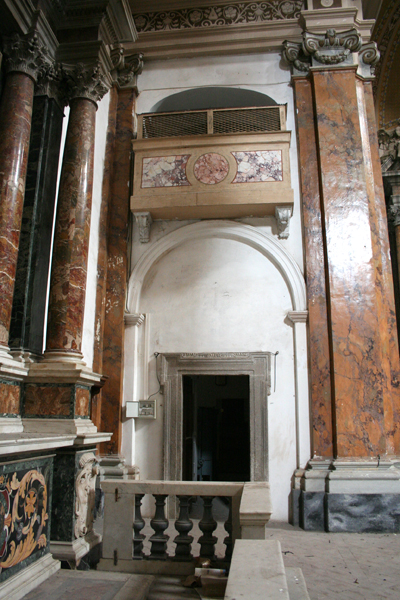
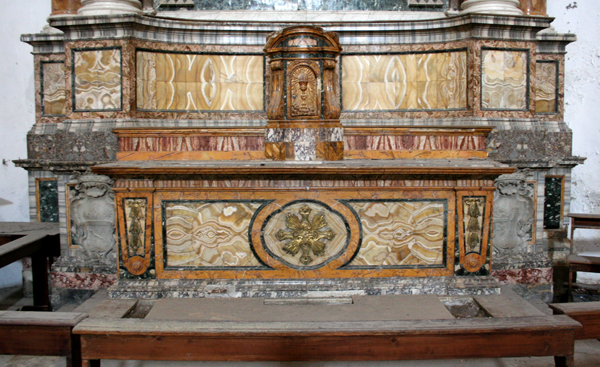
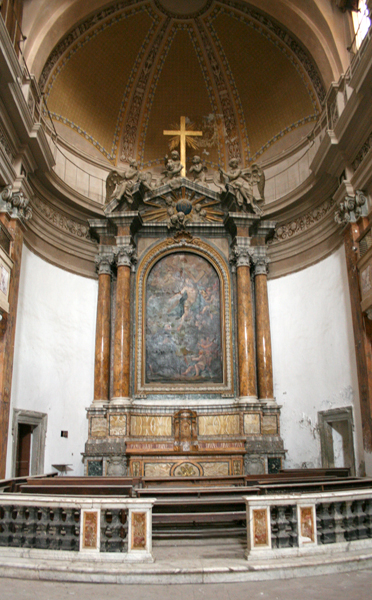
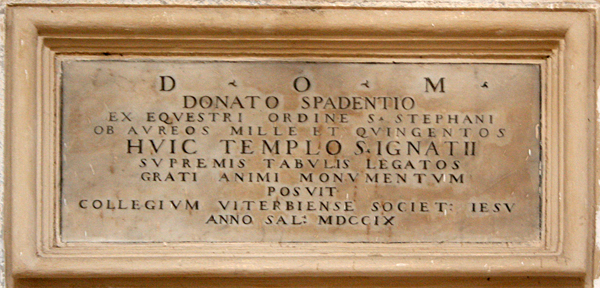
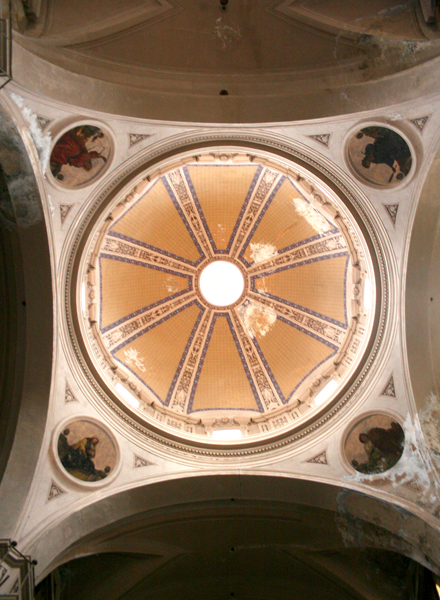
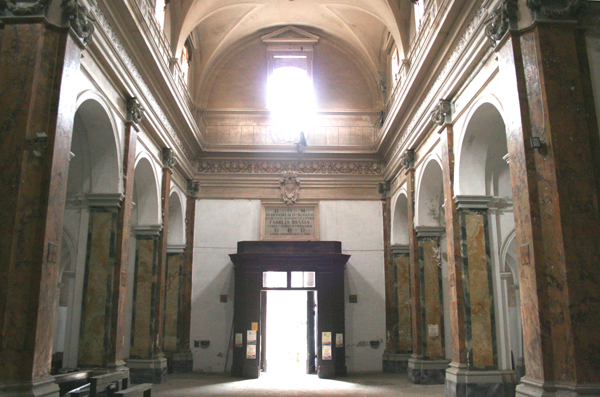
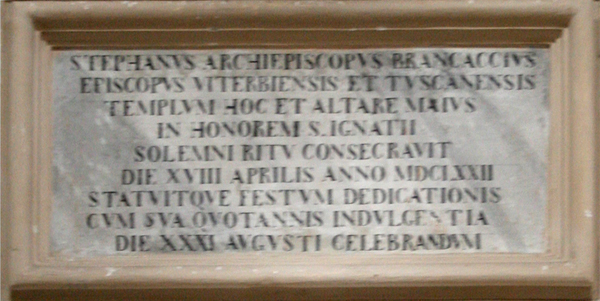
The church is composed of three aisles. In the side aisle opens many chapels. At the right of the entry is the painting of rising Angels made by an unknown artist, with frame golden with two cherubs. Following the coat of arms of the Spadenzi. Signorelli, the famous historian from Viterbo, he describes it like “blue, with two swords of silver, trim of gold, pass in crosses of S. Andrea, overflow of three lilies of gold, clear up in bandage. Under is the inscription of Feliciano Bussi from 1709 was put on small door of the sacristy near the chapel of S. Francesco Borgia founded in 1703. D.O.M./ Donato Spadentio/ex equestri Ordine S.Stephani/ ob aureos mille et quingentos/huic templo S.Ignatii/supremis tabulis legatos/grati animi monumentum/ posuit/ Collegium Viterbeiense Societ:Iesu/anno MDCCIX. (see photo) Donated by Spadenzi contributed with 1,500 shields of gold to the foundation of the church. Following the golden frame there is a painting made in ‘700 by a follower of Anton Angelo Bonifazi representing the image of S. Francesco. In small is written Sacellum hoc S. Francisci/ Borgia clientis a terremotus/periculis vindicati ex orna/ runt/an 1709. Following the chapel of S. Franceso Saverio, constructed in 1677 by Domenico Sannelli and decorated to the cost of his son Ludovico. We know that the following year Bartolomeo Malavista made the body of the saint in silver and inserted in the chapel. The chapel is rich of rare, valuable marble. Front of the altar with the center one opening assembled for the insertion of the relics with an oval and rhombs with roses. On the surface is one slab with inscription of Domenico Sannelli, also more in low is the coat of arms of Sannelli family carved in peperino stone on the tombstone. At the side we find a baroque organ without more the pipes or the tool. The bigger altars were patronage from the Bruni Franceschini family. Their coat of arms was composed by a Lion, a tower ending at the Ghibellines way and drawn of two roses. At the top between two columns is a painting made of oil colors with Christ crucified that appears to S. Ignazio Esequito, made by Ludovico Mozzanti in 1745-6. According to the story of the life of S. Ignazio, former soldier of Pampolna, he was coming to Rome and stopped in the village of La Storta there Christ appeared to him. The tabernacle is made of splendid polychrome marble. On the right side of the altar is an inscription with the image of Pope Leone XIII commemorative of the 75th year of the first communion of the Holy Father with the writing in golden letters. He himself when he was a clerical student received the first communion of the church of S. Ignazio in 1821. On the left of the apsis there is an inscription found in the catacombs of Protestato it was found, on the tomb of one young martyr called Irene Dulcis and carved one heart of which is one arrow. In 1854 the inscription was added to the tombstone: Has v. et. m. reliquias nomini Irene Dulcis inscriptas / Romae in caemeterio Praetextati inventas / atque a Pio papa IX donatas / Mattheus Eustachius Gonella neocesareensis archiep. / apud Belgarum regem legatus / in suo sacello publicae / venerationi exponebat / habita a pontifice maximo facultate / quot annis prima dominica septembris / sacrum solemniter celebrandi / anno / MDCCCLIV. In the top dome we find decorations on the vele platform made by Pietro Vanni in 19th Century while at the midpoint of the arch of the aisle and on the counter is the coat of arms of Pope Leone XIII. Following Calabresi’s Chapel, built in 1687 by Girolamo Calabresi together with a stonemason from Rome. On the antependium of the altar there are two large garlands of flowers. There was a painting on the altar, a Madonna and Child presented with a resemblance to the Madonnas of Murillo. The Corentini attributed the canvas to Bartolomeo Cavarozzi. The painting was stolen in 1999 and was later recovered. In the second passage there is an inscription which commemorates the consecration of the church by the bishop Brancaccio which took place April 18th, 1672. Stephanus archiepiscopus brancaccius/ episcos Viterbiensis Tuscanensis et/ templum hoc et altare maius/ in honorem S. Ignatii/solmni ritu consecravit/ die XVIII aprilis anno MDCLXXII/ statuique festumdedicationis/ cum sua quotannis indulgentia/ die XXXI augusti celebrandum. The ceiling is decorated with ornaments and flowers classic of 800. The ancient texts speak of a picture present in the sacristy with a Crucifixion attributed the Michelangelo.
Traduzione di Danielle Maddock, University of Nevada, Reno e Alicia Bertram, University of New Mexico, Albuquerque. Programma USAC presso Università degli Studi della Tuscia.
ESSENTIAL BIBLIOGRAPHY
AA. VV., Tuscia Viterbese, vol. I, Roma, 1968.
F. Bussi, Istoria della città di Viterbo, Roma, 1742.
Attilio Carosi, Chiese di Viterbo, Viterbo, Agnesotti, 1995.
Dizionario della Pittura e dei Pittori, Torino, Einaudi, 1989.
F. Egidi, Guida della città di Viterbo e dintorni, Viterbo, 1889.
Italo Faldi, Mostra di restauri, in “L’arte nel viterbese”, Viterbo, 1965.
Italo Faldi, Museo Civico di Viterbo. Dipinti e sculture dal Medioevo al XVIII secolo, Viterbo, 1955.
Italo Faldi, Pittori viterbesi di cinque secoli, Roma, 1970.
Italo Faldi, Restauri acquisti e acquisizioni al patrimonio artistico di Viterbo, catalogo, Viterbo, Palazzo dei Priori, 1972.
Augusto Gargana, Viterbo. Itinerario di Augusto Gargana, Viterbo, 1939.
Il 1400 a Roma e nel Lazio. Il 1400 a Viterbo, cat. mostra, Roma, De Luca Editore, 1983.
La pittura in Italia, Milano, Electa, 1989.
A. Muñoz, Uno sguardo al nuovo Museo Civico di Viterbo, in “Per l’inaugurazione del Museo Civico di Viterbo”, Viterbo, Agnesotti, 1912, pp. 33- 45.
G. Oddi, Le arti in Viterbo, Viterbo, Agnesotti, 1882.
Cesare Pinzi, I principali monumenti di Viterbo. Guida pel visitatore, Viterbo, Agnesotti, 1911.Cesare Pinzi, Storia della città di Viterbo, voll. I-III, Roma, 1887/89, vol. IV, Viterbo, Agnesotti, 1913.
A. Scriattoli, Viterbo nei suoi monumenti, Roma, 1915-20.
Giuseppe Signorelli, Viterbo nella storia della Chiesa, Viterbo, 1907-1969.
Mario Signorelli, Guida di Viterbo. Monumenti del centro cittadini, Viterbo, Agnesotti, 1964.
Mario Signorelli, Storia breve di Viterbo, Viterbo, Agnesotti, 1964
Simona Valtieri, La genesi umana di Viterbo, Roma, 1977.
A.Scriattoli, Viterbo nei suoi monumenti, Viterbo, 1905
M.Galeotti, Illustrissima città di Viterbo, Viterbo,2001


