Author:
Location:


FONTANA GRANDE
HISTORY AND DESCRIPTION
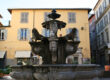
Fontana Grande was built in the year 1212 by the will of the City, the Fontana Grande is certainly the most famous among the fountains found throughout the city. Its creation was entrusted to stone masons, Pietro and Bertoldo di Giovanni, whose names appear in the lower basin of the epigraph placed on the fountain. The fountain took the place of the Fontem Sepalis (mentioned in documents of the Liber Censum in 1192). It was subject to restoration as early as 1206.This name appears to be linked to the presence of a series of columns joined by horizontal bars of iron, which act as a fence (SEPES = shelters). The name “great” appears for the first time in a notarial protocol from May 11, 1483 drawn up by Tommaso d’Andrea. The notarial protocol remembers a house located in the district of the “great fountain”, a name that appeared officially on a list of fountains beginning in 1565. The Greek cross structure of the lower basin, as well as the central pillar on which two cups are stacked and topped by a finial, are the result of a series of restorations that happened over the centuries. The first restoration was conducted in 1279 at the behest of the mayor Orso Orsini, which was followed by another in 1424. Pope Martino V financed this restoration. The lower tank, the central part of the column and the four lion heads were achieved during that time. The pyramids, now inserted in the bottom of the structure, date back to 1827 and were executed by architect Domenico Lucchi, simultaneously with the restoration of the upper central trunk. However, these changes did not alter, the Gothic style. The purpose was to give momentum to the Romanesque structure of the base.
FONTANA GRANDE. Traduzione di Amanda Santini, California State University, Stanislaus. Programma USAC presso Università degli Studi della Tuscia.
ESSENTIAL BIBLIOGRAPHY
AA. VV., Tuscia Viterbese, vol. I, Roma, 1968.
F. Bussi, Istoria della città di Viterbo, Roma, 1742.
Attilio Carosi, Chiese di Viterbo, Viterbo, Agnesotti, 1995.
Dizionario della Pittura e dei Pittori, Torino, Einaudi, 1989.
F. Egidi, Guida della città di Viterbo e dintorni, Viterbo, 1889.
Italo Faldi, Mostra di restauri, in “L’arte nel viterbese”, Viterbo, 1965.
Italo Faldi, Museo Civico di Viterbo. Dipinti e sculture dal Medioevo al XVIII secolo, Viterbo, 1955.
Italo Faldi, Pittori viterbesi di cinque secoli, Roma, 1970.
Italo Faldi, Restauri acquisti e acquisizioni al patrimonio artistico di Viterbo, catalogo, Viterbo, Palazzo dei Priori, 1972.
Augusto Gargana, Viterbo. Itinerario di Augusto Gargana, Viterbo, 1939.
Il 1400 a Roma e nel Lazio. Il 1400 a Viterbo, cat. mostra, Roma, De Luca Editore, 1983.
La pittura in Italia, Milano, Electa, 1989.
A. Muñoz, Uno sguardo al nuovo Museo Civico di Viterbo, in “Per l’inaugurazione del Museo Civico di Viterbo”, Viterbo, Agnesotti, 1912, pp. 33- 45.
G. Oddi, Le arti in Viterbo, Viterbo, Agnesotti, 1882.
Cesare Pinzi, I principali monumenti di Viterbo. Guida pel visitatore, Viterbo, Agnesotti, 1911.Cesare Pinzi, Storia della città di Viterbo, voll. I-III, Roma, 1887/89, vol. IV, Viterbo, Agnesotti, 1913.
A. Scriattoli, Viterbo nei suoi monumenti, Roma, 1915-20.
Giuseppe Signorelli, Viterbo nella storia della Chiesa, Viterbo, 1907-1969.
Mario Signorelli, Guida di Viterbo. Monumenti del centro cittadini, Viterbo, Agnesotti, 1964.
Mario Signorelli, Storia breve di Viterbo, Viterbo, Agnesotti, 1964
Simona Valtieri, La genesi umana di Viterbo, Roma, 1977.