Author:
Location:
Date:


The construction of the fountain in the courtyard of the palace was undertaken in 1624 at the behest of the City Council. The palace was the base of the governor’s estate, then of the priors and now of the mayor.


FOUNTAIN OF PALAZZO DEI PRIORI
THE HISTORY
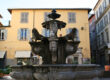
The construction of the fountain in the courtyard of the palace was undertaken in 1624 at the behest of the City Council. The palace was the base of the governor’s estate, then of the priors and now of the mayor. IIt is the work of stonemasons Pieruccio Antonio, Agostino Prosperi and Leonetto Corrarini. The design is attributed to the painter Philip Caparozzi from Viterbo, he was also the author of the elegant balustrade of the courtyard and the two side niches. The works lasted well beyond 1624. In May 1625 the construction of the wall began for extending the cloister and the fountain it was judged imperfect with the risk that they couldn’t accomplish the work, given the lack of necessary funds. Work continued in the last months of 1627, with the intent to fix the entire courtyard of the palace, including the fountain. Unfortunately, in 1635 and in 1637 violent storms damaged the fountain compromising its stability. During the nineteenth century, the fountain underwent several operations of restorations that have altered its appearance. For example, the two lions placed on the top that hold the palm tree were carved in 1898 by Carlo Jelmoni. Commemorating the city coat of arms, the lions are distinguished for their agility in elegant contrast to the dignified and austere medieval depictions.
DESCRIPTION
The fountain is located on three steps that serve as the base and are surrounded by a deep flush to drain water. It is formed by two cups overlaid with bath Gorgons. On the parapet of the pool appear the arms of Genoese Girolamo Grimaldi, deputy governor of Viterbo from 1625 to 1628. In poor condition, there is an eagle with wings spread and head turned to the right. Two pairs of dolphins with large eyes placed at the junction of the two fountain pools to give a fairly elegant fountain. They claim the corner the first cup-shaped oval, which lets out the water from the mouths of four lions, supported by balustrade scales’ shape decorated, is the last cup, smaller than the previous one. That one is also oval and lets the water fall through the cracks on the edge of the cup itself, creating a suggestive rain effect. At the top there is a bronze group, a symbol of the city coat of arms, and the palm of Ferento flanked by two lions with forelegs resting on it and the lion’s head facing the Palazzo dei Priori. Serving as framework there are railings at the fountain, patterns including scales’ s shape motifs and two fountains inside two niches with elliptical cup resting on a pedestal in the shape of a lyre, richly decorated. The water comes out from the lion’s jaw, all covered by a double shell and on the bow there is another lion’s head. On the top is placed a vase.
FOUNTAIN OF PALAZZO DEI PRIORI. Traduzione di Amanda Santini, California State University, Stanislaus. Programma USAC presso Università degli studi delle Tuscia.
ESSENTIAL BIBLIOGRAPHY
C. Piana Agostinetti; Fontane a Viterbo, Fratelli Palombi Editori, Roma 1985, pp. 70-71.
B. Corradini; Le fontane di Viterbo, La Sponda, Roma 1998, pp. 18-21.
F. Nicolai; Bartolomeo Cavarozzi “disegnatore” di fontane e la storia della fontana nel cortile del Palazzo dei Priori, in “Biblioteca e società” (2003), Anno XXII, 1, pp. 38-42.
M.G. Monelli; Palazzo dei Priori, in Il centro storico di Viterbo, cura di M.G. Gimma, Betagamma Editrice, Viterbo 2001, pp. 150-161.
M. Galeotti; L’illustrissima Città di Viterbo, Edizioni Studio Pubblicitario Viterbese, Viterbo 2002, pp. 460-461.