Author:
Location:
Date:




FOUNTAIN OF SAN FAUSTINO
THE HISTORY
The Fountain of San Faustino was built around 1251. It is located in Piazza S. Faustino, inside the city walls since the year 1210. The fountain is off center from the old town center, the square level was lowered in 1927. The district was populated in 1172 when the inhabitants of Ferento, following the destruction of their city were accused of heresy. Later, around the fifteenth century, the nuns arrived in the district because they were forced by bandits and soldiers to leave Ferento. In the district, the painter Lorenzo di Jacopo was born. He was the creator of the frescoes in the chapel of Mazzatosta, located inside the Chiesa di S.Maria della Verità. The construction of the fountain was funded by the inhabitants of the district, as reflected by a statute of 1251. An inscription between the heads of a lion bears the names of two masters, engraved in Gothic letters: Iacobus Andree et Geminus Magistris tri francisci fecerunt h(oc) opu(s), Iacopo di Andrea and Geminus of Master Francesco. In 1550 the fountain was enriched with new water from Rispoglio. Over the centuries it has been restored three different times with private funding, the community and church gave money to put water inside the fountain. In 1865, the steps were restored (Reforms vol. I 171, 1865 f. 4000) because this constituted a danger to those who wished to draw water.
DESCRIPTION
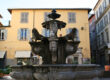
The fountain is made with peperino stone and presents the typical spindle shape. The base consists of five concentric steps surrounded by a fence formed by bars that are supported by peperino blocks. The tank is delimited by a parapet decorated with rectangular panels bounded vertically by plates. The spindle is divided into three zones, the lower column finished with a collar that has four lion heads from which the water comes out. The middle octagonal pyramid is decorated with coats of arms in relief each repeated twice. At the top of the spindle there is an element consisting of 4 acanthus leaves with curled spikes, which are arranged to form a bud, which rest on a pine cone. On the bottom of the tank, 4 blocks of peperino are located. On top of these blocks there are supported containers to collect water.
FOUNTAIN OF SAN FAUSTINO. Traduzione di Amanda Santini, California State University, Stanislaus. Programma USAC presso Università degli Studi della Tuscia.
ESSENTIAL BIBLIOGRAPHY
AA.VV. Il centro Storico di Viterbo, Betagamma, Viterbo, 2001, p. 206
Scriattoli, Viterbo nei suoi monumenti, Roma, 1915, p. 310
Agostinetti, Fontane a Viterbo. Roma, 1985, p. 44